Key Points
- Silver prices reached a new all-time high of $61.62 per ounce, marking a 104% annual advance, driven by inflation hedging and industrial demand.
- The metal’s dual role as an inflation hedge and an industrial component for AI data centers and electric vehicles intensified demand.
- Supply constraints, including low stockpiles in Shanghai and increased imports due to expected 2026 tariffs, contributed to the price surge.
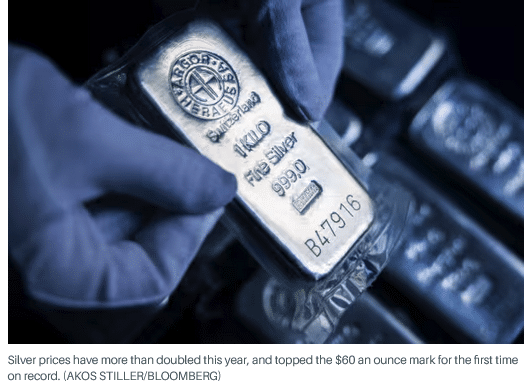
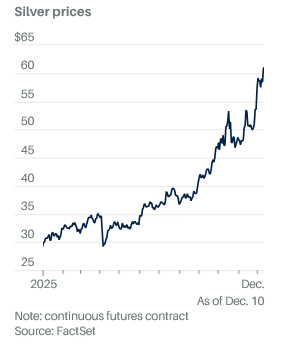
Silver prices +3.60% surged to a fresh all-time high on Wednesday, topping the $60 an ounce mark for the first time on record, as investors continue to seek inflation hedges and industrial alternatives to goldGC00+1.02% and digital currencies.
The white metal is finding a place in investment portfolios as both a hedge against inflation and the protection against currencies losing value, as well as an industrial play on new technologies powering global growth.
Silver remains a key component in the buildout of artificial-intelligence data centers and the production of electric vehicles, both of which have intensified demand and catapulted prices over the past year. It’s also used in solar cells and anti-bacterial medical instruments.
Spot silver prices were 1.6% higher in Wednesday trading, changing hands at $61.62 an ounce. The metal’s price has more than doubled this year.
Gold prices, which also hit record highs again last month, have risen around 60% this year.
“Silver’s relentless surge in 2025 will be remembered as one of the most dramatic revaluations in modern precious metals history,” said Saxo Bank’s head of commodity strategy Ole Hansen.
“Having spent much of the past decade oscillating between being perceived as a monetary metal and an industrial input, silver finally resolved that identity crisis this year by being both at the same time — just as supply constraints became impossible to ignore,” he added.
Silver’s place on the list of “critical minerals” published by the U.S. Geological Survey was also completed last month, and tariffs expected on the metal in 2026 have stoked an enormous wave of imports that has drained supply in other markets around the world.
“This has put other regions under pressure,” said Ewa Manthey, commodities strategist at ING. “Stockpiles in warehouses linked to the Shanghai Futures Exchange recently hit their lowest in nearly a decade, with a large volume shipped to London to ease the squeeze there.”
Manthey expects this dynamic, as well as expected central bank policy easing and U.S. dollar weakness, will continue to support silver prices into the coming year.
“Historically, silver has outperformed gold during easing cycles, as lower real yields tend to lift both investor allocation and industrial activity,” she said.
Hansen at Saxo Bank also notes that even if longer-dated government bond yields continue their recent climb and prevent central banks from delivering rate cuts, silver is still likely to outperform.
“While higher long-end yields would normally be a headwind for precious metals, this time they may send a different signal—namely unease about inflation persistence and fiscal expansion,” he said. “In that scenario, higher yields could paradoxically reinforce demand for silver and gold as portfolio hedges.”
One challenge for U.S. investors, however, is finding a blue-chip play on silver demand outside of the spot and futures markets.
The world’s biggest listed silver mining company, Mexico-based Fresnillo is listed on the London Stock Exchange. Other companies, such as Pan America SilverPAAS+3.66% and Hecla Mining, carry modest market values of around $20 billion and $10 billion, respectively.
That has driven retail investors into silver-backed exchange-traded funds, which have taken in more than 130 million ounces this year, an 18% increase from 2024 levels.
However, speculators are reducing their bets on extended gains, thanks in part to increased volumes and volatility. Commodity Futures Trading Commission data now suggest the number of investors betting on near-term price increases has fallen to the lowest level in 19 months.
“Given that silver’s market turnover is roughly eight to ten times smaller than gold’s, this imbalance matters,” Hansen cautioned. “It helps explain why relatively modest shifts in gold prices or silver sentiment in general can translate into outsized moves—both up and down.”
Read the full article HERE.