

“This is no country for old men” said Irish poet WB Yeats in his lyrical poem Sailing to Byzantium back in 1926. It was a year marked by recession, political turmoil, and market volatility. It was just three years before the Wall Street crash, and gold was the asset of the well-to-do, the ‘powers that be,’ and the established class. Indeed, it was by far the preferred investment of tycoons, titans and yes — old men.
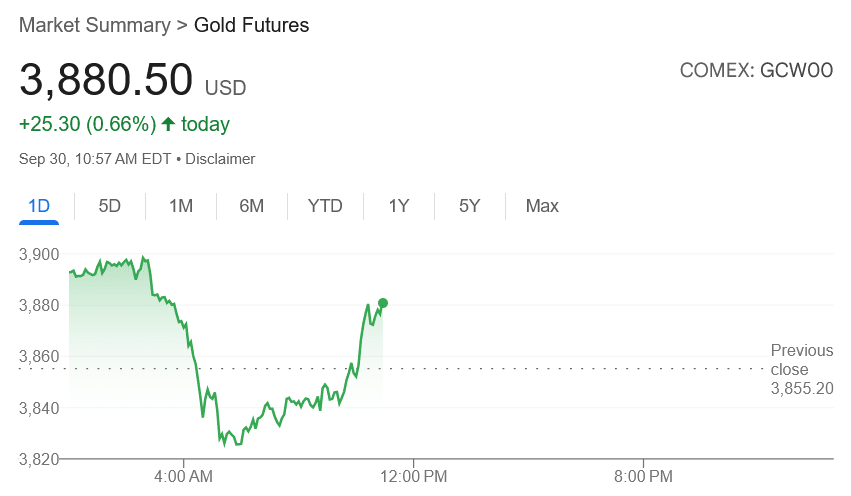
Almost 100 years later, everything has changed. Once an extravagance of the rich and famous, gold is now one of the best performing investments of the year. In 1926 an ounce of gold was a mere twenty bucks — now it has surpassed $3800/oz. While gold has long been considered a safe haven and a chaos hedge, a recent Blackrock Market Insight points to gold’s new long-term profit potential.
“Historically, higher real rates and a strong U.S. dollar have served as headwinds for gold. Recently the price of gold has continued to advance despite these factors with support stemming from central bank purchases and growing U.S. deficits. In this environment, gold is less likely to act as a hedge to equities but rather as a long-term store of value.”[1]
The allure of gold for investors has expanded to include those seeking economic security as well as anyone looking for a dynamic asset with a significant upside within the current economic landscape — particularly younger generations.
Gold is a Modern Portfolio Enhancer
Due to gold’s historically low correlation to other assets like stocks, bonds and cash — it continues to provide protection for financial portfolios that are heavily leveraged in paper investments. According to the World Gold Council (WGC), gold improves portfolio diversification particularly during periods of market volatility and economic crisis.
“Gold has a key role as a strategic long-term investment and as a mainstay allocation in a well-diversified portfolio. Investors have been able to recognize much of gold’s value over time by maintaining a long-term allocation and taking advantage of its safe-haven status during periods of economic uncertainty.”[2]
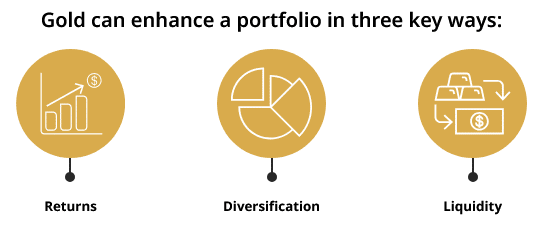
Gold increases portfolio balance and protection via three key attributes:
a) Its ability to generate returns b) Its power as a diversifier c) Its high liquidity as a universally recognized and desirable asset.
Central Banks are Hoarding Gold
Gold has never been more popular with central banks than right now. They have accumulated over 1,000 tons of gold each of the last three years — and are on track for a fourth year of robust buying.
They world’s leading monetary authorities are not only looking to diversify their portfolios by reducing their reliance on the U.S. dollar, but to also protect against economic sanctions, market uncertainty, and the fallout of destabilizing geopolitical conflicts.
“Central banks have been net buyers of gold for the past 15 years, but the speed of their purchases doubled in the wake of Russia’s invasion of Ukraine. As the US and its allies froze Russian central bank funds held in their countries, it underscored how foreign currency assets are vulnerable to sanctions.”[3]
And, there is no indication that the central bank gold grab will slow down anytime soon. A recent World Gold Council Central Bank Gold Reserves Survey suggests that 95% of central banks believe their gold reserves will continue to grow over the next year.[4]
Young Investors are Making Gold Great Again

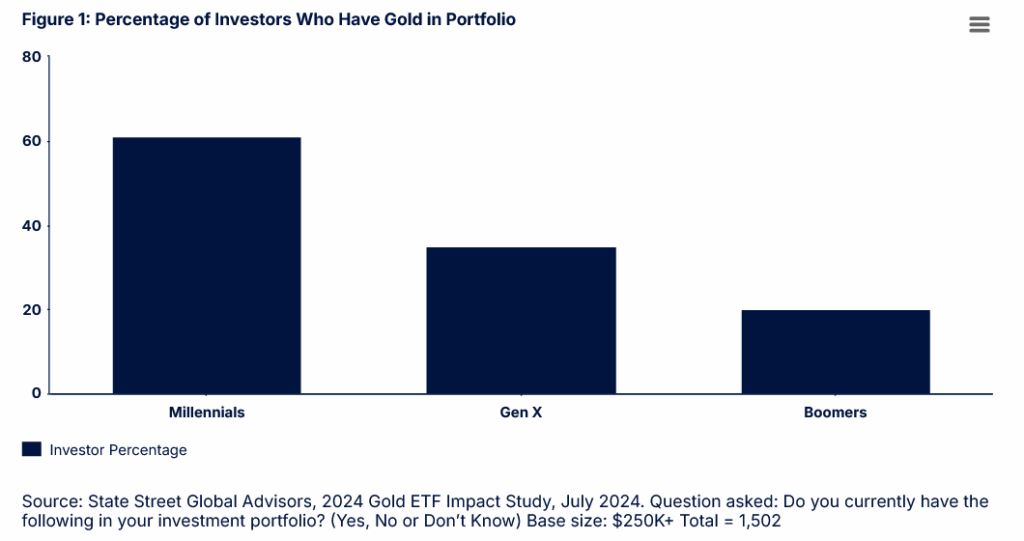
“More than 60% of millennials now include gold in their portfolios. That’s significantly higher than the 35% of Gen X and 20% of boomers who hold gold. What’s more, millennials’ average gold allocation has soared from 17% in 2023 to 29% today, well above the 10% and 13% respective averages for boomers and Gen X.”[5]
Like Millennials, Gen Zer’s are growing up amid a cost-of-living crisis, geopolitical uncertainty and crushing federal debt. They too are entering the precious metals market seeking a safe haven, a hedge against inflation, and to quell their sense of mistrust in government and financial systems.
“A younger generation, shaped by new financial crises, digital innovation, and a growing mistrust of traditional systems, is embracing gold in its own way. Gen Z, and Millennials, once seen as all-in on crypto, NFTs, tech stocks, and social trading, are now turning to gold as a tangible, time-tested asset … For Gen Z, gold’s appeal is not just about value preservation but also about privacy. They are finding that one of the simplest ways to achieve full privacy over their capital is to convert fiat currency, which exists as data in a highly transparent, centralised banking system, into physical gold held securely outside of it.”[6]

As these new generations, now some 145 million strong, continue to enter the gold market — they are reshaping the future of gold investing as well as the broader appeal of precious metals. Far more than the peer groups that preceded them, they understand that gold is a tangible asset that does not require an internet connection, a digital transaction, or a software application. And it is therefore not vulnerable to hacking, phishing, data breaches, cyber intrusion, digital infiltration and online privacy concerns.
In Sailing to Byzantium, WB Yeats alludes to gold’s permanence and timelessness as an enduring element. From a “gold mosaic on a wall” to the “hammered gold” of “Grecian goldsmiths,” it resides in “the artifice of eternity.” And this aspect of imperishability has clearly captured a new generation making gold sought after, highly valued, and hip again.
Courtesy of Thor Metals Group. 1-844-944-THOR.
[1] https://www.blackrock.com/us/individual/insights/stay-long-gold
[2] https://www.gold.org/goldhub/research/relevance-of-gold-as-a-strategic-asset
[3] https://www.bloomberg.com/news/articles/2025-09-18/gold-price-record-how-tariffs-inflation-us-rate-cut-are-fueling-bullion-rally
[4] https://www.gold.org/goldhub/research/central-bank-gold-reserves-survey-2025
[5] https://www.ssga.com/us/en/individual/insights/millennials-spearhead-gold-rush-as-safe-haven-appeal-soars
[6] https://masterinvestor.co.uk/latest/solomon-global-why-gen-z-and-millennials-are-buying-gold/#
For generations physical gold has served as a “safe haven” asset, meaning it tends to retain its value in times of economic volatility or crisis. Due to its physical properties, gold is often described as having intrinsic value attributable to its rarity, beauty, practical uses, and long history as a symbol of wealth.

In a modern financial portfolio, gold is considered to be a critical “hedge” or a type of investment that reduces the risk of losing money on another investment. Investopedia aptly describes it as “a risk management strategy to offset losses in investments by taking an opposite position in a related asset.”[2]
Indeed, gold has not only proven itself to be a consistent and reliable store of value, but it offers critical protection against some of the most credible threats to the savings and retirement accounts of everyday investors.
Inflation Hedge
When the price of food, housing, clothing, energy, healthcare, gasoline, and airfare skyrockets — it is deemed an ‘inflationary cycle.’ This can be particularly punishing for consumers since they get less goods and services for their money. During periods of inflation Americans lose ‘purchasing power’ which means the value of the dollar diminishes.

Gold is a celebrated inflation hedge which means it’s a stable store of value that retains its purchasing power when currencies depreciate. While paper money typically loses value over time, gold’s value holds steady due to its limited supply, universal acceptance, and historical significance.
“Back in 1929, the average house price in the US was around USD $6,500. Fast-forward to 2024 and the average house price shot up to around USD $420,000, showing just how much a dollar has fallen in value over that period. However, in 1929, 10kg of gold was worth around USD $7,300 – just enough to buy the average house. But by 2024, the same amount of gold was worth around USD $830,000 – nearly enough to buy two houses. Security risks aside, this suggests it’s a much better idea to stash away gold under your bed than cash.”[4]
Volatility Hedge
Historically, gold has had an inverse correlation to the stock market particularly during periods of pronounced market uncertainty and volatility. Since gold is considered to be a safe haven asset, investors tend to pile in when equities experience steep price swings, corrections, and/or panicked selling.
According to the World Gold Council, during periods of high-risk on Wall Street, gold’s wealth-protecting attributes set it apart and make it the preferred asset choice.
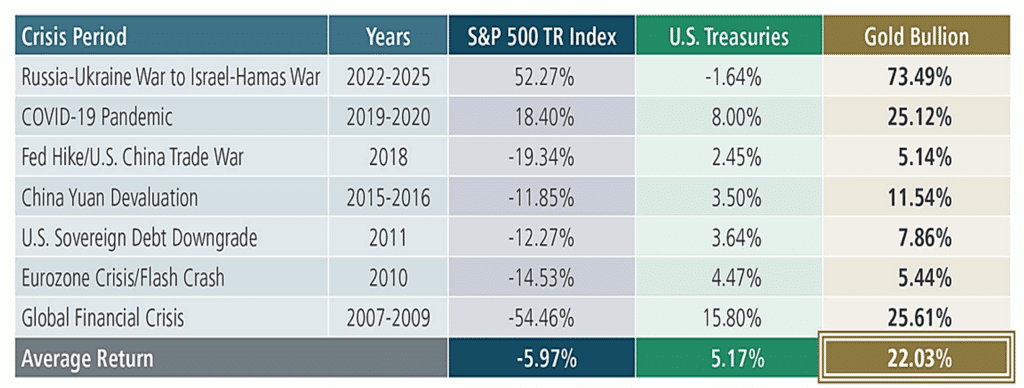
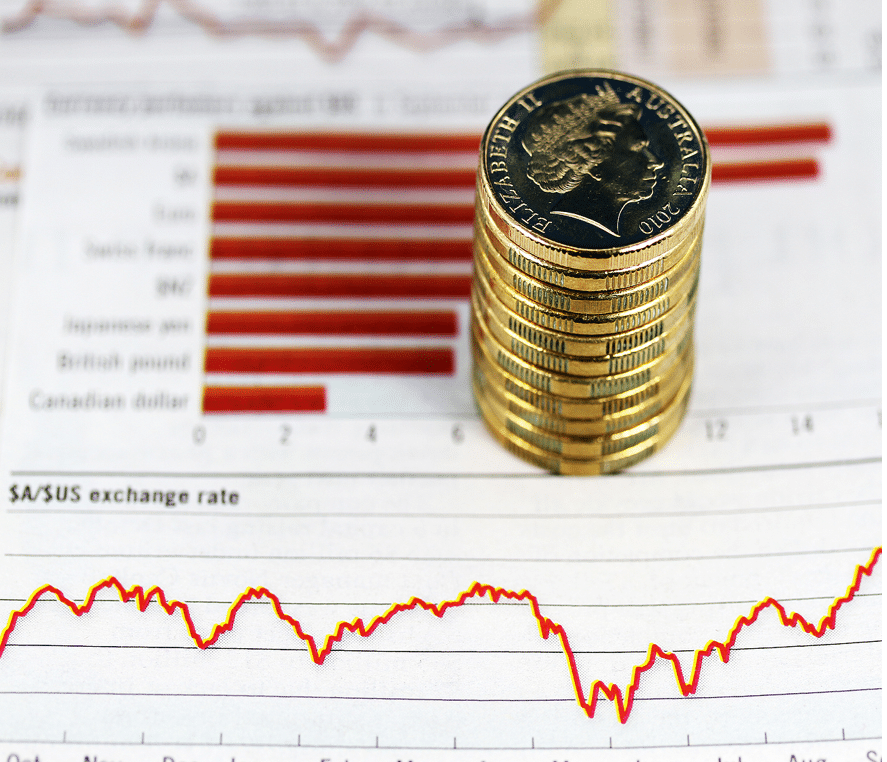
But it is during periods of economic downturn, crashes and recessions that gold shines brightest.
According to Sprott Management, gold is the ‘go-to’ safe haven during market moving events like Russia’s recent invasion of Ukraine, the pandemic of 2019-202,0 and the global financial crisis of 2007-2009.[6]
In 2025, as the stock market struggled with a significant mid-year downturn, gold reached consecutive all-time highs and outperformed other major assets classes, surging more than 37% year-to-date.
Recession Hedge
Gold is not only a viable hedge against Wall Street volatility; the price of the precious metal also tends to rise during full-blown economic downturns and recessions. Gold has experienced significant strength during financial contractions like those of the 1970s, 1990s, 2000s and the more recent Covid-19 recession.
This characteristic, underscores gold’s protective qualities amid financial turbulence.
Gold’s appeal during a recession not only hinges on its historical performance but also its safety attributes of stability, liquidity, limited supply, consistent demand and the psychological comfort of holding a tangible asset with material value.
The Corporate Finance Institute lists gold as a ‘hard asset’ which it deems to be a sound alternative to ‘soft assets’ particularly stocks and bonds during times of recession:
“Hard assets are non-perishable and possess intrinsic value … As an investment alternative, hard assets provide security in times of uncertainty, market instability, and volatility. They retain value regardless of how far their market prices may drop.”[8]
It is gold’s unique ability to preserve purchasing power, protect against a weak dollar, offset losses in a stumbling market, and preserve wealth amid a full-blown economic crisis that make it a hedge for now, for later, and for always.
Get information on buying Gold at: 1-844-944-THOR or visit: www.ThorMetalsGroup.com
[1] https://www.ig.com/en/trading-strategies/why-is-gold-valuable–230810
[2] https://www.investopedia.com/trading/hedging-beginners-guide/
[3] https://www.pgpf.org/article/what-is-inflation-and-why-does-it-matter/
[4] https://www.juliusbaer.com/en/insights/wealth-insights/how-to-invest/the-allure-of-gold-a-hedge-against-inflation-and-market-volatility/#
[5] https://www.gold.org/goldhub/data/gold-correlation
[6] https://sprott.com/investment-strategies/exchange-listed-products/physical-bullion-funds/the-case-for-gold-in-crises/
[7] https://discoveryalert.com.au/news/recession-impact-gold-prices-performance-2025/
[8] https://corporatefinanceinstitute.com/resources/commercial-lending/hard-assets/
In 2025, platinum has become an appealing and often overlooked investment. It is rarer than gold, has a higher melting point, more high-tech uses, and is up over 45% year-to-date — significantly outperforming every other precious metal this year.
Platinum is also in the midst of a significant supply crisis as demand continues to outpace world reserves. According to mining publication, Discovery Alerts, platinum is confronting a ‘perfect storm’ of converging supply factors. “Years of underinvestment in mining capacity combined with operational challenges in South African mining have constrained supply just as demand is accelerating across multiple sectors.”[1]

While all the gold ever mined in the world would fit into a cube of roughly 72 to 75 feet on each side, all the platinum ever mined would fit into a cube of just 17 feet on each side.
In terms of non-investment uses, platinum’s melting point, according to the University of Bristol, is significantly higher than gold. “In its purest form it melts at 3214 degrees F, almost twice the temperature needed to melt 14 karat gold.”[2] This makes it suitable for a host of high temperature applications — particularly in industry, technology, energy and weaponry. Platinum’s unique characteristics, limited supply and many uses make a strong case for its undervaluation.
Catalytic Converters
Platinum is a critical component of catalytic converters. A catalytic converter is a mandatory device found in the exhaust system of all gas-powered cars. These ‘emissions control’ devices make auto engine pollutants less toxic.

“A catalytic converter lies between a car’s engine and its exhaust pipe. It contains catalysts to remove pollutants from the car’s engine, by converting them into harmless emissions.”[3] This specialized automotive device uses chemical reactions with precious metals like platinum to clean dangerous exhaust from automotive engines.
According to Thermo-Scientific,
“Catalytic converters are pollution control devices coated with chemicals and a combination of the platinum group metals (PGM) platinum (Pt), rhodium (Rh) and/or palladium (Pd). The PGMs are responsible for the conversion reactions that turn pollutants into harmless gases. Most present-day vehicles that run on gasoline, including more than 98% of new cars sold worldwide each year, as well as trucks, buses, trains, motorcycles, and planes have exhaust systems with a catalytic converter.”[4]
Over the last five years, automotive demand for platinum has been 29% to 42% of total platinum demand.[5] And as the adoption of electric vehicles faces challenges from the current administration’s rollback of climate initiatives along with disappointing EV sales — platinum automotive demand is forecast to remain robust.
Hydrogen Applications
Platinum also acts as a catalyst in hydrogen electrolyzers and fuel cells. The former produces “green hydrogen” as a clean fuel source while the latter generates electricity to power motors.
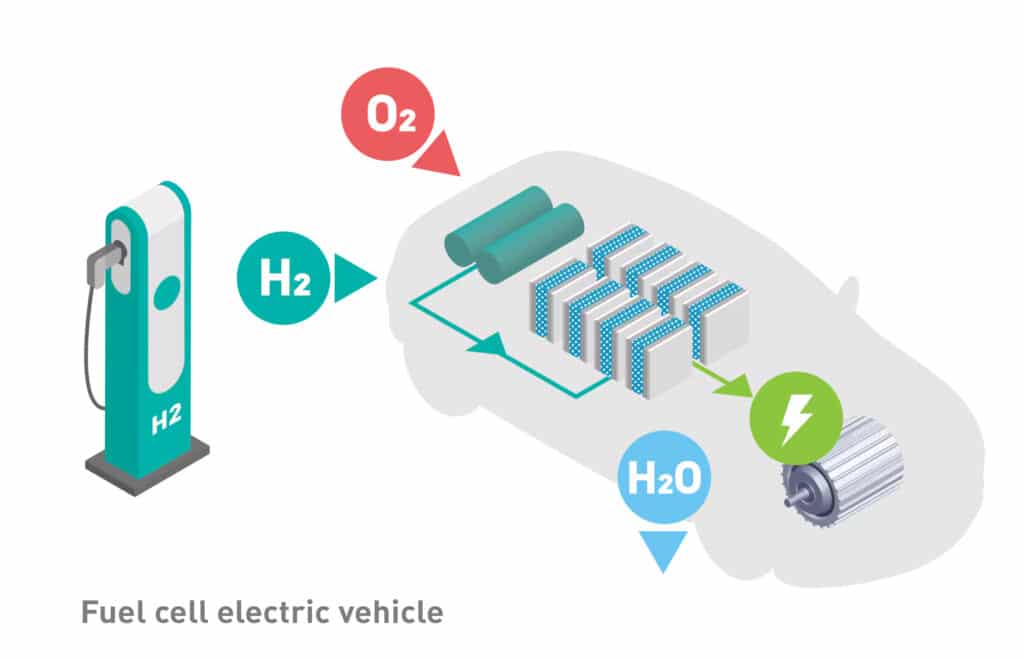
“Platinum’s role is particularly significant in proton exchange membrane (PEM) technologies, which are essential for both hydrogen production and utilization. PEM electrolyzers, which generate hydrogen by splitting water molecules using electricity, depend on the metal serving as a catalyst.”[6]
According to the World Platinum Investment Council, platinum is a critical component of hydrogen fuel cells which provide emissions-free power and a viable alternative to electric batteries.
Fuel cells in heavy-duty vehicles such as trucks and buses are currently leading the growing market for Fuel Cell Electric Vehicles (FCEVs).[7]
Hydrogen-powered trains are already in commercial use. Trucks and buses are currently in production while mass transport involving sea and air travel are in the testing and prototype phases.
Rising green energy demand and the fuel cell revolution, will propel the platinum catalyst market from a projected $1.2 billion last year to $2.5 billion by 2033. And it will be largely driven by both technological advancements and government mandates.[8]
Hydrogen energy is widely seen as a vital decarbonization tool and according to the International Energy Forum, “platinum’s role in the energy transition could lie in making clean hydrogen technologies commercially viable.”[9]
Defense and the Military
Modern military readiness incorporates precision jets, missiles, rockets, thermal and infrared technologies, and heat-seeking weapons — and platinum makes them all work.

According to Investing News, NATO’s increased defense spending commitment is shining a light on the role of platinum and other minerals deemed critical to modern weaponry and military technologies:
“Aircraft engines rely on platinum and rhodium for temperature sensing, while platinum is also used as a protective plating for turbine blades. In missile systems, platinum and iridium are incorporated into nose cones for their ability to withstand extreme heat. Military vehicles also draw on platinum for catalytic converters and infrared suppression systems, which help reduce thermal visibility against heat-seeking weapons.”[10]
On June 25, 2025, the heads of NATO agreed to raise their defense expenditure to 5% of their GDP annually by 2035, a dramatic increase from the previous 2% mark. This is a boon for platinum which is has emerged as a critical element of the modern war machine. Militaries around the world rely on Platinum Group Metals (PGMs) for critical vehicle and aircraft capabilities:
- Catalytic converters using platinum reduce emissions from military vehicles, meeting increasingly stringent environmental standards while maintaining operational capability
- Thermal signature suppression technology utilizing platinum coatings reduces vulnerability to infrared detection and heat-seeking weaponry—a critical survival feature in modern combat environments
- Temperature-sensing components made from platinum-rhodium alloys provide precise monitoring in extreme-temperature environments like jet engines and rocket motors
- Heat-resistant components incorporating various PGMs enable operation in conditions where conventional materials would fail, extending operational capabilities[11]
Platinum’s high melting point, extreme heat tolerance, conductivity and catalytic properties are essential for many defense technologies. It has proven to be a strategic metal for the national defense systems of NATO and most major military units around the world making it a critical component of war readiness.
Platinum is significantly less expensive than gold. It is also caught in a severe structural supply deficit as demand is growing across multiple high-tech categories including clean energy and military capability. This is why savvy investors are acquiring platinum coins, bars and even IRA approved bullion.

DID YOU KNOW?
- The Hope diamond, a famous sizeable blue-colored diamond, is set in platinum.
- King Louis XVI of France heralded platinum the “only metal fit for kings”.
- Just four mines (one in Russia and three in South Africa) account for 90% of the world’s platinum production.[12]
Contact Thor Metals Group at 844-944-THOR to obtain Investment-Grade Platinum
—
[1] https://discoveryalert.com.au/news/platinum-supply-squeeze-2025-south-africa-deficits/
[2] https://www.chm.bris.ac.uk/~paulmay/webprojects1997/JonathanT/info.htm
[3] https://matthey.com/science-and-innovation/knowledge-hub/what-is-a-catalytic-converter#sectionend-mbxz_
[4] https://www.thermofisher.com/blog/metals/new-reduced-platinum-catalyst-for-catalytic-converters/
[5] https://platinuminvestment.com/about/demand-drivers
[6] https://investingnews.com/hydrogen-economy-platinum-demand/
[7] https://platinuminvestment.com/about/hydrogen-demand
[8] https://www.ainvest.com/news/platinum-price-navigating-geopolitical-risks-green-energy-demand-shifting-market-2508/
[9] https://www.ief.org/news/energy-transition-to-trigger-huge-growth-in-platinum-for-hydrogen
[10] https://investingnews.com/nato-defense-spending-pledge-highlights-pgms/
[11] https://discoveryalert.com.au/news/platinum-group-metals-defense-aerospace-2025/
[12] https://www.thmarch.co.uk/insights/what-is-platinum-interesting-platinum-facts-and-uses/
The world is currently mired in record-setting debt. Last year, the combined borrowing of households, businesses and governments across the globe eclipsed $315 trillion. And in the first quarter of this year, global debt surged by another $7.5 trillion, reaching a new high of $324 trillion.
Heavy global debt loads can lead to widespread economic instability, currency devaluation, reduced private and public investment and an increased risk of a global fiscal crisis.
And one of the consequences of mounting debt levels in today’s environment are the skyrocketing debt servicing costs—or the amount of money required to not only repay borrowed loans but also the interest that has accrued on those loans.
The impact on business is particularly pronounced as rising global debt can undermine consumer spending, trigger higher borrowing fees, suppress available capital and result in corporate bankruptcies and/or insolvencies.
Global Debt-To-GDP Ratio
Nearly every country in the world holds debt, but some nations are more vulnerable than others in what is now considered to be a “High-Debt, Slow-Growth World.”
At over $36 trillion, the United States owes more money than any other country in the world, and America’s debt burden is increasing on average by about $1 trillion every three months. The U.S. is followed by China, with a national debt of around $18 trillion, and Japan, with around $9 trillion of sovereign debt.
While high debt figures are worrisome for any economy, a nation’s debt-to-GDP ratio is a more critical measure of financial health since it indicates a country’s ability to repay its liabilities relative to the size of its economy. The higher the ratio, the less likely it is that a country possesses the economic output to pay back its loans.
Based on data from the IMF World Economic Outlook, here are the countries with the highest debt-to-GDP correlation:
• Sudan: 252% of GDP
• Japan: 235% of GDP
• Singapore: 175% of GDP
• Greece: 142% of GDP
• Bahrain: 141% of GDP
• Maldives: 141% of GDP
• Italy: 137% of GDP.
• United States: 123% of GDP
• France: 116% of GDP
• Canada: 113% of GDP
Each of these nations has a debt tally that exceeds their total economic output or the overall value of all of the goods and services produced within their respective borders. At almost 123% of GDP, America’s debt liability not only threatens the solvency of essential programs like Social Security, Medicaid and Veteran’s benefits—it also elevates the risk of a financial crisis.
The Precarious Value Of Money
Global debt has been rising for well over a decade, but Covid-19 and the resulting lockdowns, business closures, government assistance and relief programs impacted global debt accrual. The fallout of black swan events like wars and pandemics can trigger higher interest rates, increase inflationary pressures, depress economic growth, erode investor confidence and depreciate the value of money.
History provides an infamous example of debt-driven currency devaluation in the case of the German Papiermark. In the 1920s, money was printed to pay off war debt and fund reparations, which led to crippling hyperinflation. The “mark” became so worthless that iconic photos of German citizens using banknotes as wallpaper serve as a sobering reminder of how quickly and completely debt can destroy the value of legal tender.
The Global Safety Net
Investment advisors, wealth managers and portfolio planners who position gold as an essential asset class could help their clients tap into its benefits as a strong diversifier, a stable long-term investment and a commodity with the potential for significant capital appreciation.
As with any investment, though, it’s important to note that acquiring gold does carry some downside. First, it is considered a non-yielding asset, meaning it doesn’t pay interest or dividends like CDs, bonds, stocks or Treasurys. Secondly, storing pure gold coins or bars is an added consideration and possibly an added expense. Gold needs to be kept in a secure environment safe from theft, corrosives, moisture and possible natural disasters, etc.
In addition, the price of gold can be volatile. It is heavily influenced by ever-changing demand triggers. For instance, gold has traditionally had an inverse relationship with Wall Street and the dollar. So, when the markets are high and the dollar is strong, gold prices tend to slump—and vice versa. Additionally, sometimes gold is negatively correlated to interest rates.
But in 2025, gold has defied many longstanding historical norms and traditional benchmarks. Record-setting world debt and steady and consistent central bank demand have made it one of the best-performing assets of the year, exceeding projections and surpassing price targets.
So, it’s important to think carefully about gold beyond short-term market fluctuations, interest rate chatter and even potential tariffs because long term, it could become a go-to asset.
The information provided here is not investment, tax, or financial advice. You should consult with a licensed professional for advice concerning your specific situation.
It was 1912 — and a tumultuous time in world history. It was the year the Titanic sank, the last Emperor of China abdicated, Serbia and Greece declared War on the Ottoman Empire, and Woodrow Wilson was elected U.S. President in a landslide.
It was also a time when many began to question the concentration of money and power among the privileged few, particularly in the U.S. financial system which was run by a coterie of wealthy bankers, traders and power brokers who had free reign over the ‘money trust’ and all forms of credit.
“Money is gold, and nothing else”
In May of 1912, a U.S. Congressional Sub-Committee (the Pujo Committee) was assembled to investigate influence peddling, conflicts of interest, price manipulation, and lack of oversight within the banking sector. The head of major banks and financial institutions were called to testify including representatives from National City Bank of New York, Lee, Higginson & Co., Kidder, Peabody & Co., Kuhn, Loeb & Co. as well as the Chairman of the First National Bank of New York, George F. Baker and the head of J.P. Morgan & Company, John Pierpont Morgan.
SUBCOMITTEE OF THE COMMITTEE ON BANKING AND CURRENCY, HOUSE OF REPRESENTATIVES, WASHINGTON, D.C., THURSDAY, DECEMBER 19, 1912, 10:30am Mr. Morgan: What I call money is the basis of banking. Mr. Untermyer: But the basis of banking is credit, is it not? Mr. Morgan: Not always. That is an evidence of banking, but it is not the money itself. Money is gold, and nothing else. Mr. Untermyer: Do you not know that the basis of banking all over the world is credit rather than gold? Mr. Morgan. It is the basis of credit, but it is not the basis of money.
In a famous exchange with Samuel Untermyer, chief counsel for the government, financier J.P. Morgan makes a clear distinction between gold, a tangible asset with intrinsic value — and fiat currency, paper money, and all forms of credit.[1]
What Did Morgan Mean?

J.P. Morgan was among the most powerful and prominent figures of his day. The Library of Congress described him as a titan of American business whose position and connections put him squarely in the middle of the development of American industry.[2]
Morgan actually used his wealth and influence to save the U.S. from several financial disasters:
“The commonly known story of the Panic of 1907 is that in October of 1907 an attempt by F. Augustus Heinze, an overzealous Wall Street banker, to corner the copper market led to a run on many major banks. The effects of the run caused a panic that reverberated throughout Wall Street, New York City banks and ultimately, many of the U.S. banking and manufacturing industries. At the height of the Panic, J.P. Morgan stepped in to aid the banking community and quell the massive drop in bank reserves and market collapse.”[3]
Morgan’s position on gold was quite clear. He believed it was the only form of real money — a physical asset with intrinsic value that was not government-issued, credit-based, subject to mismanagement, or devaluation. Some, 110 years later the JP Morgan Private Bank concurs with its namesake about the historical importance of gold and its contemporary benefits.
“Gold has been a sought-after commodity for centuries, and a popular component in investment portfolios in modern times. The metal has historically delivered attractive long-term returns … gold has exhibited a low, or sometimes negative correlation to traditional asset classes, such as equities and bonds. In our view, having gold as a part of your asset allocation makes sense as a portfolio ballast that helps to enhance the risk-return profile.”[4]
Why Gold is More Relevant than Ever

Today, there are many different ways to pay for things: credit cards, debit cards, bank transfers, mobile payments, digital wallets, bitcoin, checks and of course cash. But J.P. Morgan would argue that none of them are real money precisely because they’re either a representation of money, an electronic transfer of credit, a digital ledger balance, or a promise to pay at a later date.
And all of them lack intrinsic value or inherent and objective worth that is not imparted by any country, financial institution, technology network, banking entity, or outside entity.
According to Investopedia, gold’s enduring strength and relevance come from its rich history:
“Like no other commodity, gold has held the fascination of human societies since the beginning of recorded time. Empires and kingdoms were built and destroyed over gold and mercantilism. As societies developed, gold was universally accepted as a satisfactory form of payment. In short, history has given gold a power surpassing that of any other commodity on the planet, and that power has never really disappeared.”[5]

For J.P. Morgan, holding gold instilled power, stability, predictability, and protection from financial crisis. Amid the Panic of 1893, as unemployment soared, businesses closed, banks failed, and as U.S. gold reserves became dangerously depleted — it was J.P. Morgan who stepped in to help the federal government replenish its gold supply to help stabilize the economy.
According to investment research firm ByteTree, gold remains more important than ever and the evidence of an “undeclared gold standard” is now mounting.
“The remarkable thing is that the gold standard withered in the 1970s, and other than the recent rumors surrounding a gold-backed BRICS currency, there has been no official need for central banks to own gold. They do so out of choice. It is remarkable how an informal gold standard of sorts is returning despite it being formally vanquished half a century ago. It means that gold is once again relevant despite that not being written down in the statute books.”[6]
The Apple Did Not Fall Far …
It’s interesting how much the world of finance has changed and yet the importance of gold has not. J.P. Morgan would likely be quite pleased by the “Key Takeaways” of the 2025 Global Research Commodities Report of JP Morgan Chase & Co, now one of the oldest and largest global financial services firm in the world:
“Given gold’s diverse and fluid drivers of demand at the moment, the metal has recently served both as a debasement hedge — or a form of protection against the loss of a currency’s purchasing power due to inflation or currency debasement — and in its more traditional role as a non-yielding competitor to U.S. Treasuries and money market funds.
- Gold prices have surged in 2025, with President Trump’s focus on tariffs pushing the metal to fresh highs.
- Longer term, the 2025 and 2026 outlook for the metal remains bullish. Prices are expected to average $3,675/oz by the fourth quarter of 2025 and climb toward $4,000 by mid-2026.
- Central bank and investor demand for gold is set to remain strong, averaging around 710 tonnes a quarter this year.”[7]
[1] https://www.sechistorical.org/collection/papers/1910/1912_12_19_Morgan_at_Pujo_C_t.pdf
[2] https://guides.loc.gov/this-month-in-business-history/april/jp-morgan-born
[3] https://www.gothamcenter.org/blog/the-panic-of-1907-how-jp-morgan-took-over-wall-street
[4] https://privatebank.jpmorgan.com/nam/en/insights/markets-and-investing/is-it-a-golden-era-for-gold
[5] https://www.investopedia.com/articles/economics/09/why-gold-matters.asp
[6] https://www.bytetree.com/research/2023/07/understanding-golds-intrinsic-value/
[7] https://www.jpmorgan.com/insights/global-research/commodities/gold-prices
There’s no doubt that the dollar’s role in the international monetary system is changing. In a world teeming with armed conflicts, soaring debt, market manipulation and what the World Economic Forum calls “an increasingly fractured global landscape,”[1] central banks are looking to protect their economies. The world’s leading monetary authorities are responsible for trillions of dollars in global bank reserves, and they’re increasingly swapping their greenbacks for gold in an effort to diversify their holdings and reduce economic risk.
The Dethroning of ‘King Dollar’?
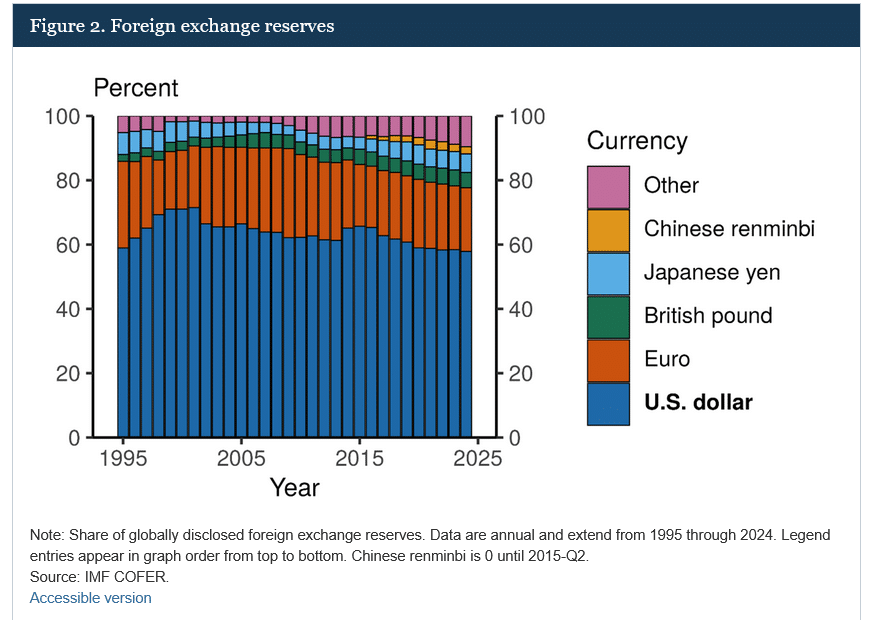
According to the Federal Reserve, the U.S. dollar represents about 58% of “disclosed global reserves” (2024) — and while it far surpasses foreign exchange reserves of other major currencies like the euro (20%), Japanese yen (6%), British pound (5%), and the Chinese renminbi (2%) — it has significantly declined from its peak of 72% back in 2001.[2]
Year-to-Date the dollar has fallen almost 9% in value, and this has gotten the attention of central banks looking to diversify their reserves to lower risk and reduce volatility. It has also prompted them to seek out higher yielding currencies and finite commodities like gold that traditionally have an inverse relationship with the dollar.
This shift reflects growing concerns about the greenback from its weakening safe haven status — to its changing role in the international monetary system. And for JP Morgan Private Bank, it also suggests a threat to U.S. exceptionalism.
“For decades, U.S. exceptionalism has been a cornerstone of global investing, powered by robust economic growth, tech dominance, high real (inflation-adjusted) yields and deep markets. Since the early 2010s, U.S. stocks have consistently outperformed, Treasuries have attracted steady demand, and the dollar has risen almost uninterruptedly … The tide may be turning. For the first time in years, the dollar looks to be unwinding its longstanding overvaluation, which could mean a 10%–20% decline over the medium term against major peers such as the euro and Japanese yen.”[3]
“The Damage Has Been Done!”
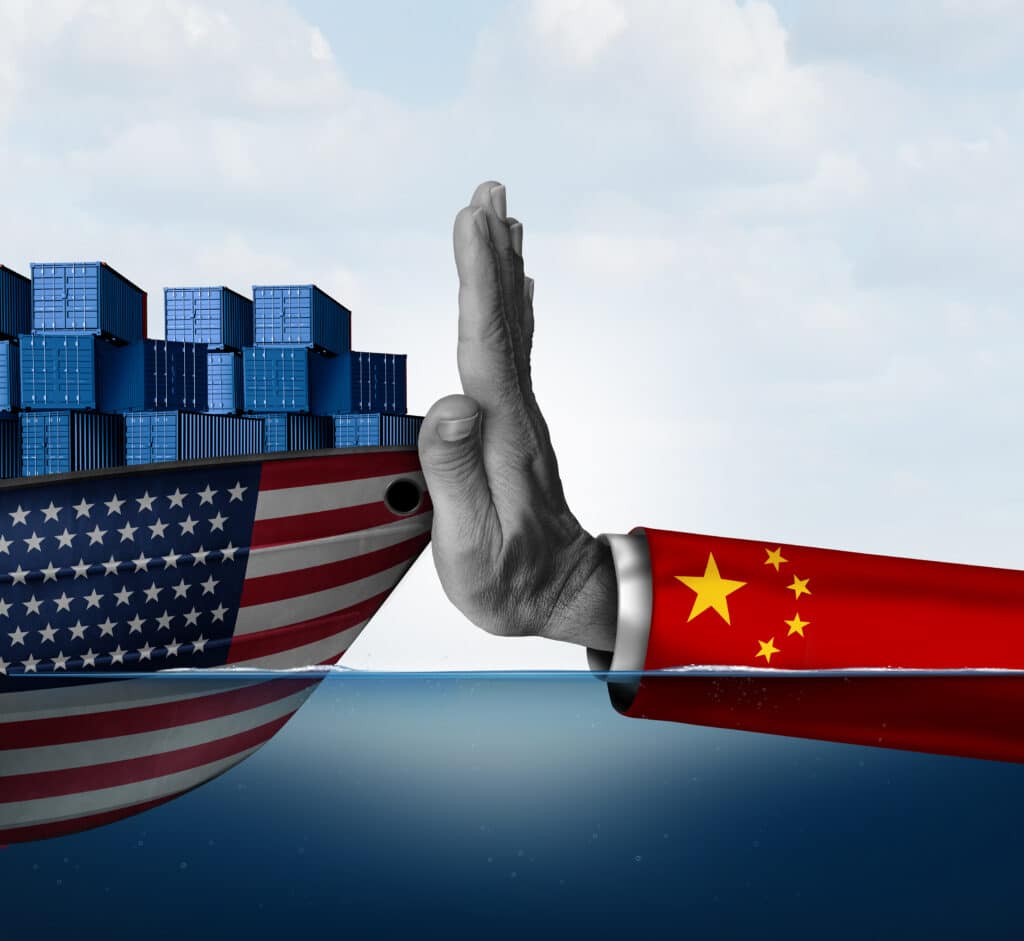
In the post-Cold War era most, major economies have feverishly amassed U.S. assets giving America “exorbitant privilege” effectively tilting the balance of economic power decidedly toward the United States.
But according to PIMCO, President Trump’s aggressive trade tactics have created added uncertainty and imbalances in the dollar-centric global financial system, reducing the attractiveness of American assets.
“With tariffs disrupting this balance, the financing of America’s twin current account and fiscal deficits may become more challenging unless there is fiscal support, as countries pursue greater economic and military self-reliance. The breakdown of longstanding global correlations could be painful for a global investor, who may be left wondering how many U.S. assets to own.”[4]
So, while Trump’s new tariff deals may be generating revenue and reducing the trade deficit with various countries, they may also be accelerating the decline of the dollar and setting the stage for a prolonged gold price surge. According to the head of foreign exchange research at Deutsche Bank, “The damage has been done. The market is reassessing the structural attractiveness of the dollar as the world’s global reserve currency and is undergoing a process of rapid de-dollarization.”[5]
The Dollar Loses Market Share
The U.S. has enjoyed immeasurable benefits of a dollar-dominated world from trade, to borrowing, to military power, and the imposition of crippling sanctions. According to the Atlantic Council, a strong dollar has not only been at the very heart of America’s superpower designation, it has also fostered global stability.
“Over the past eight decades, the status of the United States as an economic and geopolitical superpower and the role of the US dollar as the world’s dominant currency have reinforced each other. As a synonym for the dollar’s preeminent role in international currency transactions and foreign reserve holdings, dollar dominance has long been associated with the United States’ exorbitant privilege to finance large fiscal and current account deficits at low interest rates. This has helped the United States run a large defense budget and conduct extensive military operations abroad. In turn, the United States has used its military capabilities to support the free flow of goods and capital across the globe, boosting global growth.”[6]
But the dollar’s share of central bank reserves is falling. U.S. debt has just eclipsed $37 trillion and is on track to grow by $22 trillion over the next decade, and according to the Congressional Budget Office, Trump’s ‘Big Beautiful Bill’ will increase deficits over the 2025–2034 period by another $2.4 trillion.
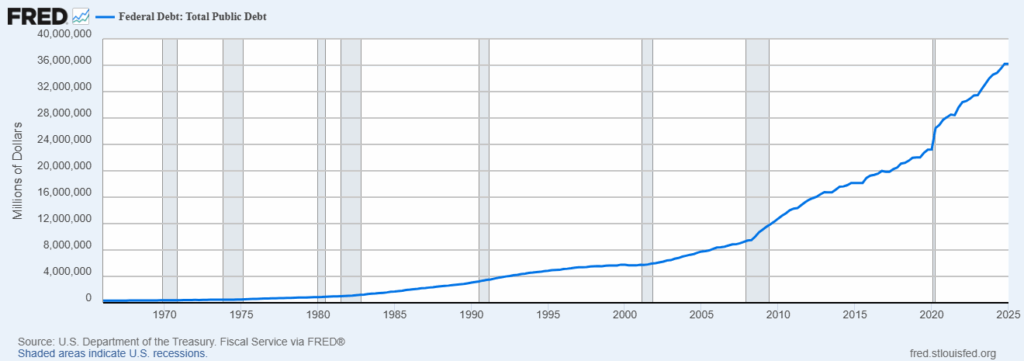
Is it any wonder that the dollar is losing market share? And its diminished capacity not only increases global uncertainty but the likelihood of economic chaos.
The Official Monetary and Financial Institutions Forum’s 2025 survey of 75 central banks and 15 public pension and sovereign funds with more than $7 trillion in combined assets — reveals the following:
- 96% of central banks flagged tariffs and trade protection as a main concern.
- 70% of central banks are increasingly worried about the US political environment
- 32% of central banks expect to increase gold holdings in the next 12–24 months, with over 20% forecasting the price to surpass $3,500 per ounce.[7]
The World Returns to Gold
The world’s central banks are stockpiling gold and have accumulated over 1,000 tons in each of the last three years, up significantly from the average of 400-500 tons over the preceding decade.[8]
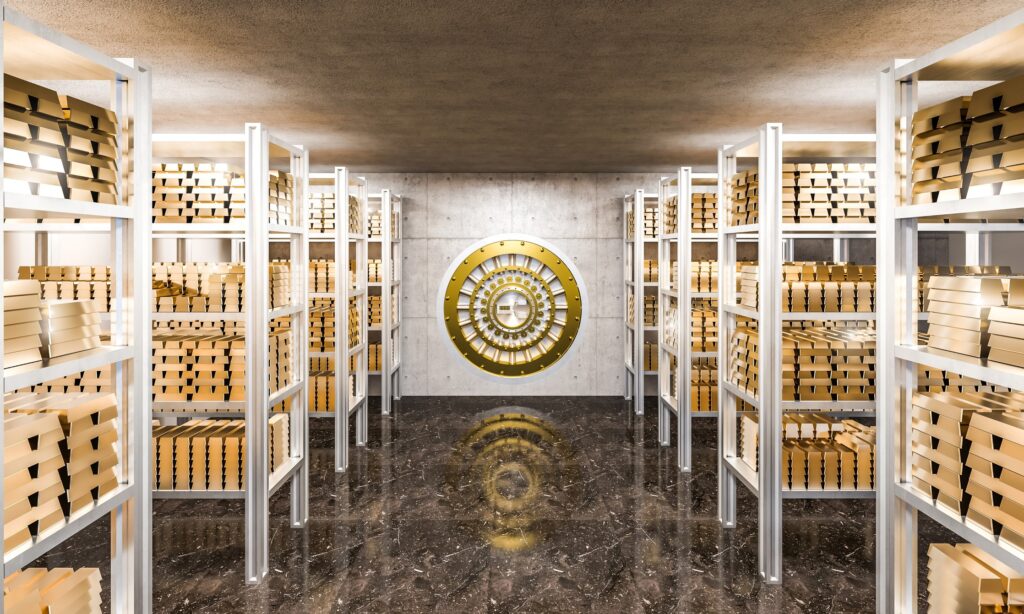
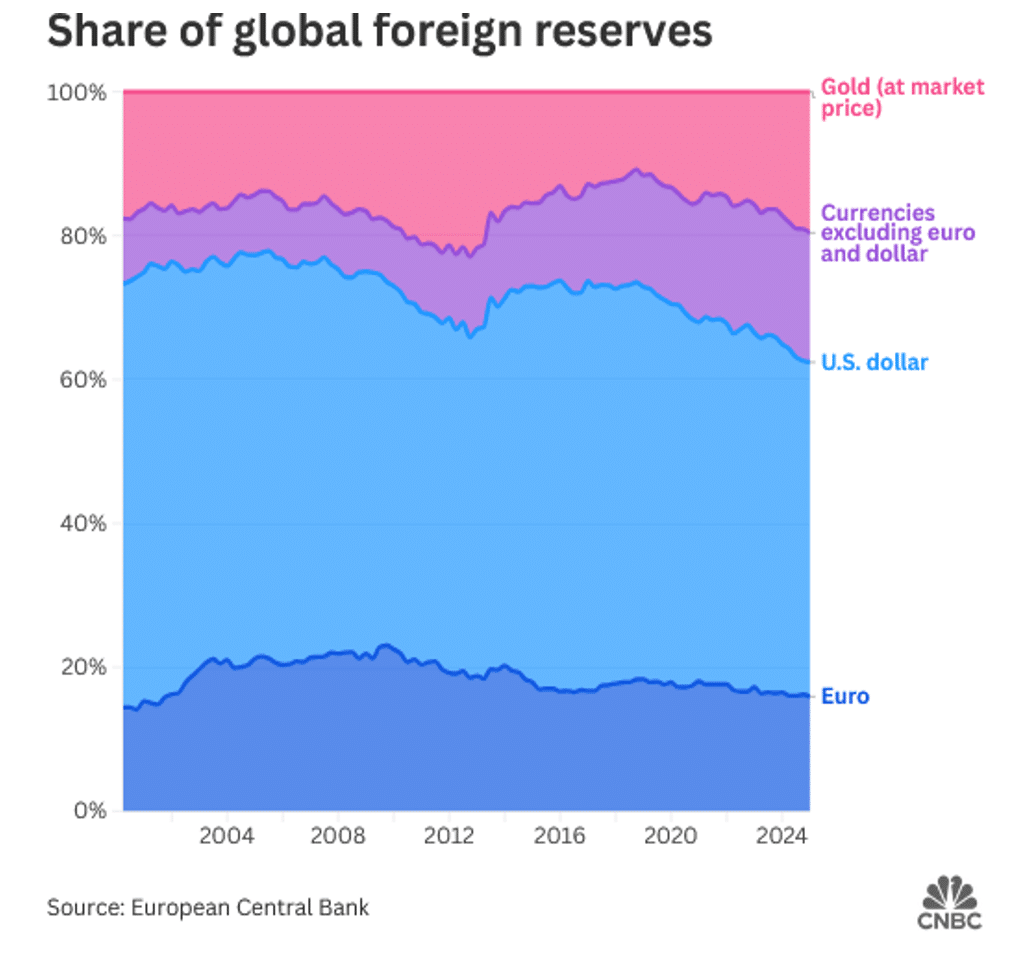
The precious metal has also just surpassed the euro as the second largest global reserve asset in the world. And with the dollar down over 5% in the past year and gold up more than 37% — it is no longer just a hedge but the new face of fiscal privilege in the dramatically shifting economic world order.
To learn more about acquiring gold and for information on opening a precious metals retirement account visit: www.ThorMetalsGroup.com
[1] https://www.weforum.org/publications/global-risks-report-2025/
[2] https://www.federalreserve.gov/econres/notes/feds-notes/the-international-role-of-the-u-s-dollar-2025-edition-20250718.html#
[3] https://privatebank.jpmorgan.com/apac/en/insights/markets-and-investing/is-this-the-downfall-of-the-us-dollar
[4] https://www.pimco.com/us/en/insights/trade-wars-and-the-us-dollar
[5] https://www.theguardian.com/business/2025/apr/11/the-damage-is-done-trumps-tariffs-put-the-dollars-global-reserve-status-at-risk
[6] https://www.atlanticcouncil.org/content-series/atlantic-council-strategy-paper-series/why-the-us-cannot-afford-to-lose-dollar-dominance/
[7] https://www.omfif.org/global-public-investor-2025/
[8] https://www.gold.org/goldhub/research/central-bank-gold-reserves-survey-2025
The World Debt Crisis Deepens
The world is currently mired in record-setting debt. Last year the combined borrowing of households, businesses, and governments across the globe eclipsed $315 trillion. And in Q1 of this year, global debt surged by another $7.5 trillion, reaching a new high of $324 trillion.
Heavy global debt loads lead to widespread economic instability, currency devaluation, reduced private and public investment, and an increased risk of a global fiscal crisis.
And one of the more dire consequences of mounting debt levels in today’s elevated rate environment, are the skyrocketing debt servicing costs — or the amount of money required to not only repay borrowed loans but also the interest that has accrued on those loans.
The impact on business is particularly pronounced as rising global debt can undermine consumer spending, trigger higher borrowing fees, suppress available capital, and result in corporate bankruptcies and/or insolvencies.
Global Debt-to-GDP Ratio
Every country in the world holds debt but some nations are more vulnerable than others in what is now considered to be a ‘High-Debt,’ Slow Growth’ era.
At over $36 trillion, the United States owes more money than any other country in the world and America’s debt burden is increasing on average by about $1 trillion dollars every three months. The U.S. is followed by China with a national debt of around $17 trillion and Japan with some $10 trillion of sovereign debt.
While high debt figures are worrisome for any economy, a nation’s debt-to-GDP ratio is a more critical measure of financial health since it indicates a country’s ability to repay its liabilities relative to the size of its economy. The higher the ratio, the less likely it is that a country possesses the economic output to pay back its loans.
Here are the countries with the highest Debt-to-GDP correlation:
- Sudan: 252% of GDP
- Japan: 234.9% of GDP
- Singapore: 174.9% of GDP
- Greece: 142.2% of GDP
- Bahrain: 141.4% of GDP
- Maldives: 140.8% of GDP
- Italy: 137.3% of GDP.
- United States: 122.5% of GDP
- France: 116.3% of GDP
- Canada: 112.5% of GDP
Each of these nations has a debt tally that exceeds their total economic output or the overall value of all of the goods and services produced within their respective borders. At almost 123% of GDP, America’s debt liability not only threatens the solvency of essential programs like Social Security, Medicaid, and Veteran’s Benefits — it also dramatically elevates the risk of a full-blown financial crisis.
The Precarious Value of Money
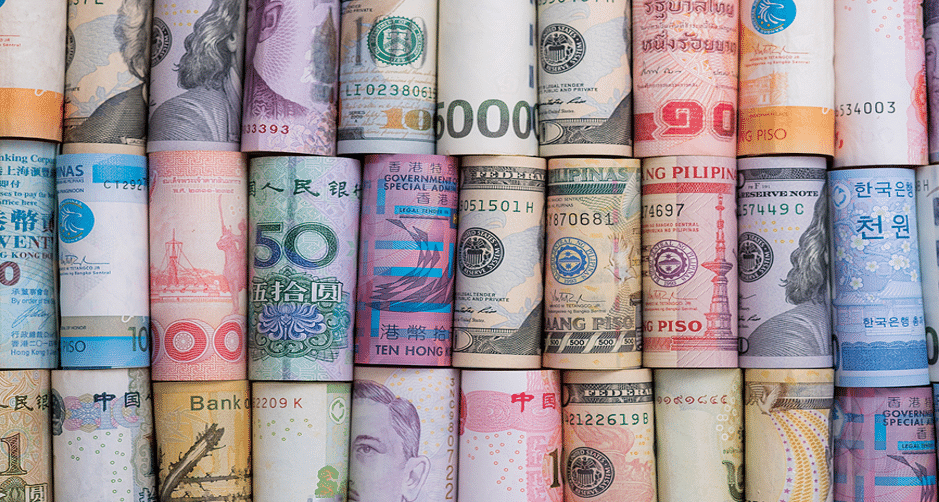
Global debt has been rising for well over a decade but Covid-19 and the resulting lockdowns, business closures, government assistance and relief programs — dramatically accelerated global debt accrual.The fallout of black swan events like wars and pandemicscantrigger higher interest rates, increase inflationary pressures, depress economic growth, erode investor confidence, and dramatically depreciate the value of money.
History provides an infamous example of debt-driven currency devaluation in the case of the German Papiermark, the official money of Germany between 1914 and 1923. Before the start of World War I, the German ‘mark’ went off the gold standard and voracious money printing ensued. Money was printed to pay off war debt, fund reparations, pay government workers, and finance massive deficits which led to crippling hyperinflation. The ‘mark’ became so worthless, that iconic photos of German citizens using banknotes as wall paper serve as a sobering reminder of how quickly and completely debt can destroy the value of ‘legal tender.’
The Global Safety Net
It is the instability of paper money that has driven central banks to acquire gold at record levels. Gold has long been recognized as a time-tested store of value — and the world’s banks are on a three-year buying spree in an effort to prop up their currencies, diversify their reserves, and protect their economies.
Gold is an inflation hedge and widely regarded as crisis insurance. It is highly liquid and globally accepted, but most of all, it is a safety net and a life line to governments plagued by the highest debt levels in history. Indeed, gold is now the world’s second largest reserve asset.
For business leaders, record-setting global debt presents a challenging economic climate. It reduces investment, increases uncertainty, undermines initiative and makes it difficult to plan, operate, and grow a business
At Thor Metals Group, we have been sounding the alarm on soaring world debt for years, addressing the growing risks to consumers, corporations, and the economy — from market instability and slower growth — to higher borrowing costs and a full-blown global recession.
Our industry leading gold reports, blogs, and precious metals experts can provide further insights into the advantages of acquiring and holding what is arguably the world’s most important physical asset, amid one of the most challenging economic periods in history.
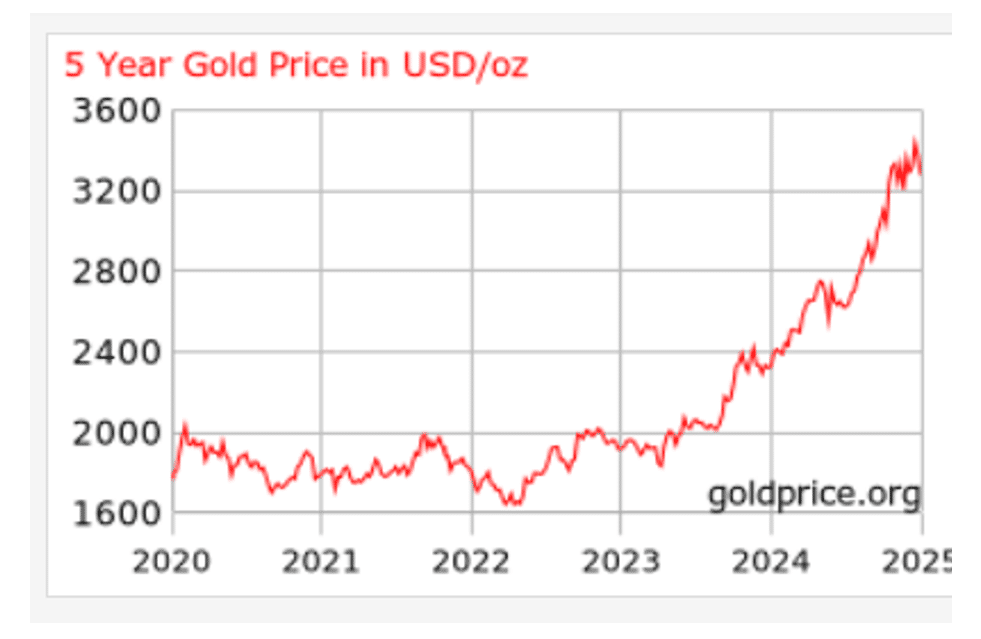
Gold’s performance in 2025 has been staggering, and there’s no shortage of opinions about the strength and depth of its ongoing bull run. Prices of the yellow metal are up over 25% year-to-date and more than 86% over the past five years. Major investment banks and financial services firms like Goldman Sachs, JP Morgan, Bank of America, and UBS have been seemingly caught off guard by gold’s unrelenting rise, triggering repeated adjustments to their official price forecasts:
In May, analysts at Goldman Sachs concluded that gold is poised to break even more records:
“Gold is increasingly in focus among traders, investors — and central banks.
The precious metal, which has been used as a financial asset for millennia, is prone to dizzying rallies and deep slumps. But despite the commodity’s volatility, gold has repeatedly set records in recent years. Since March, investors have been increasing their holdings of gold, driven by concerns about the health of the economy and market volatility. Longer term, Goldman Sachs Research expects prices to be propelled by multi-year demand from central banks. Our analysts’ gold price prediction is for these two factors to push the metal to new record highs.”[1]
Similarly, JP Morgan cites geopolitical risks, policy uncertainty and financial volatility as propelling gold to as high as $4000/oz according to their head of Global Commodities Strategy.
“Earlier this year, we examined the structural shift in gold’s demand and geopolitically influenced pricing drivers fueling its rebasing higher, ultimately posing the question if $4,000/oz is in the cards — yes, we think it is, particularly now with recession probabilities and ongoing trade and tariff risks. We remain deeply convinced of a continued structural bull case for gold and raise our price targets accordingly.”[2]
The current gold run did not start this year however — with the onset of inflation, higher interest rates, and the Russia-Ukraine War — gold prices began a gradual but steady ascent in late 2022. Since that time a confluence of factors has pushed gold to more than 60 record highs over the past two years.
The U.S. Dollar’s Very Bad Year
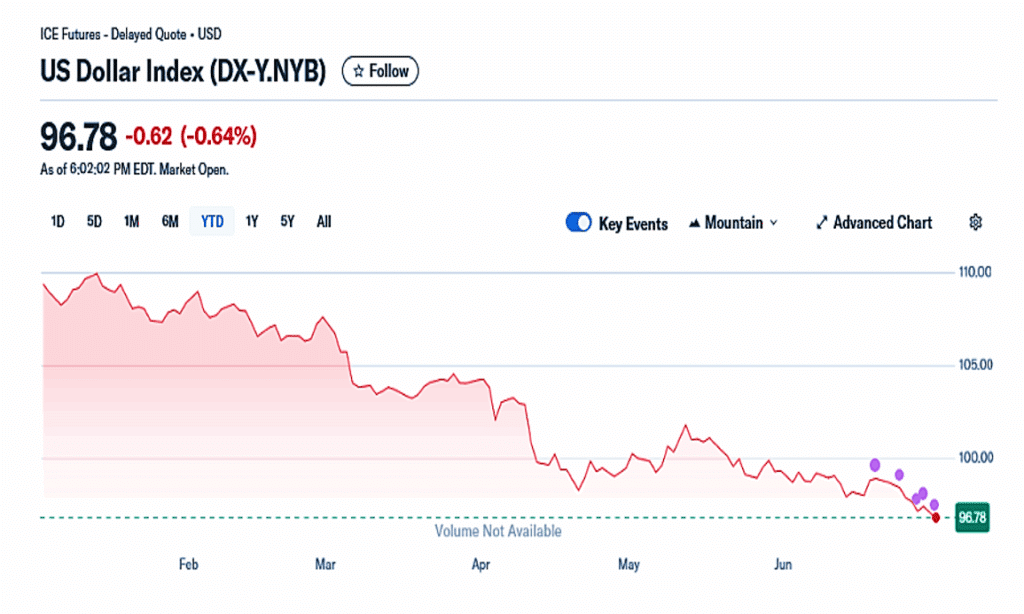
Much has been written about the ‘era of the dollar’ coming to an end and indeed gold’s view as a safe haven stronghold can be attributed to increasing threats to the dollar’s reign as the world’s reserve currency.
Last week, the dollar’s value fell to a 3-year low. The U.S. Dollar Index, which measures the of value of the buck relative to a basket of other currencies that include the Euro, Swiss Franc, Japanese, Yen and British Pound — started the year at: $108.49. It has since fallen to $96.78, setting a multi-decade record low.[3]
“The US dollar has had its worst first half-year in more than 50 years, as the financial markets over the last six months were dominated by geopolitical crises and Donald Trump’s trade war. The dollar has fallen by more than 10% against a basket of currencies since the start of 2025. That is its worst performance over the first six months of any year since 1973, and the worst half-year since the second half of 1991.This sell-off has pulled the dollar index down to its lowest level since March 2022.”[4]
There is a strong inverse relationship between gold prices and the U.S. dollar. Since gold is priced in bucks both at home and abroad, a stronger dollar makes the precious metal more expensive in other currencies, and this can suppress demand. But a weaker dollar reduces the price of gold to foreign buyers.
And there’s something else about the dollar that weighs heavily on gold prices. Many countries are actively reducing their reliance on the greenback. Whether it’s in response to trade wars, sanctions, or America’s unsustainable debt load — de-dollarization is in full swing as key nations around the world are now actively ditching dollars.
“Like many other trading powers in history, US administrations have not been averse to using economic leverage to motivate and subjugate their allies. From promoting decolonization to rebalancing expenditures, virtually every postwar American president has imposed powerful economic sanctions, or threatened to, on adversaries and allies alike to influence strategic outcomes in the US national interest. These moves had real consequences for the development of the world economy and financial markets. Above all, they stimulated a search among asset-holding governments and firms for new safe havens.”[5]
The World Turns to Gold
At this juncture in time, there is really no going back for the U.S. dollar. America’s exorbitant privilege has allowed us to borrow at lower rates, finance our deficits, exert undue influence, and grow into the world’s foremost economic superpower. But whether we’ve abused our privilege, failed to keep our books in order, or weaponized the greenback to the point of no return — other countries are embracing a world beyond the buck.
“Banks and brokers are seeing rising demand for currency derivatives that bypass the dollar, as trade tensions add a sense of urgency to a years-long shift away from the greenback. Firms are receiving more requests for transactions including hedges that sidestep the dollar and involve currencies such as the yuan, the Hong Kong dollar, the Emirati dirham, and the euro.”[6]
And gold is nipping at the dollar’s heels in terms of the world’s foreign reserve holdings. Due to historic hoarding by central banks, it has just overtaken the euro as the world’s second largest reserve asset. Central Banks are now on track to amass another 1000 metric tons of gold this year, marking the fourth consecutive year of an unrelenting gold grab. The world’s monetary authorities hold gold to protect their currencies and increase their financial safety net — and their current stockpile is at levels not seen since the 1960s.
“Central banks amass liquid assets such as foreign currencies and gold as a hedge against inflation and to diversify their holdings. It also allows them to sell these reserves to support their own currency in times of stress. Gold is seen providing long-term value and resilience through volatility, and central banks now account for more than 20% of its global demand, up from around a tenth in the 2010s.”[7]
Monetary Regime Change
Those of us who have been monitoring the dollar, market valuations, central bank activity, geopolitics, and trade relations — have been touting gold has a reliable hedge and financial safe haven. And now it seems, the entire world agrees.
Gold has reclaimed its place at the center of global finance and during this period of monetary regime change, it will once again serve as a critical bridge from the world of bills and bank notes — to whatever form of money comes next while maintaining its critical role as a timeless and transcendent store of value.
Courtesy of Thor Metals Group. 1-844-944-THOR.
[1] https://www.goldmansachs.com/insights/articles/why-gold-prices-are-forecast-to-rise-to-new-record-highs
[2] https://www.jpmorgan.com/insights/global-research/commodities/gold-prices
[3] https://finance.yahoo.com/quote/DX-Y.NYB/
[4] https://www.theguardian.com/business/2025/jun/30/us-dollar-first-half-trump-tariffs
[5] https://www.hinrichfoundation.com/research/wp/trade-distortion-and-protectionism/the-convergence-of-political-risk-economic-coercion-and-de-dollarization/
[6] https://www.bloomberg.com/news/articles/2025-05-09/global-shift-to-bypass-the-dollar-is-gaining-momentum-in-asia
[7] https://www.cnbc.com/2025/06/11/gold-overtakes-euro-as-second-biggest-global-reserve-asset.html
While gold has been grabbing world headlines as it has set repeated price records, silver has quietly rallied to an 11-year high, shattering the $30/oz mark this month. It is one of the year’s best performing commodities and yet in relative terms, silver is cheap. It currently takes about 80 ounces of silver to buy 1 ounce of gold, compared with the 20-year average of 68.[1]
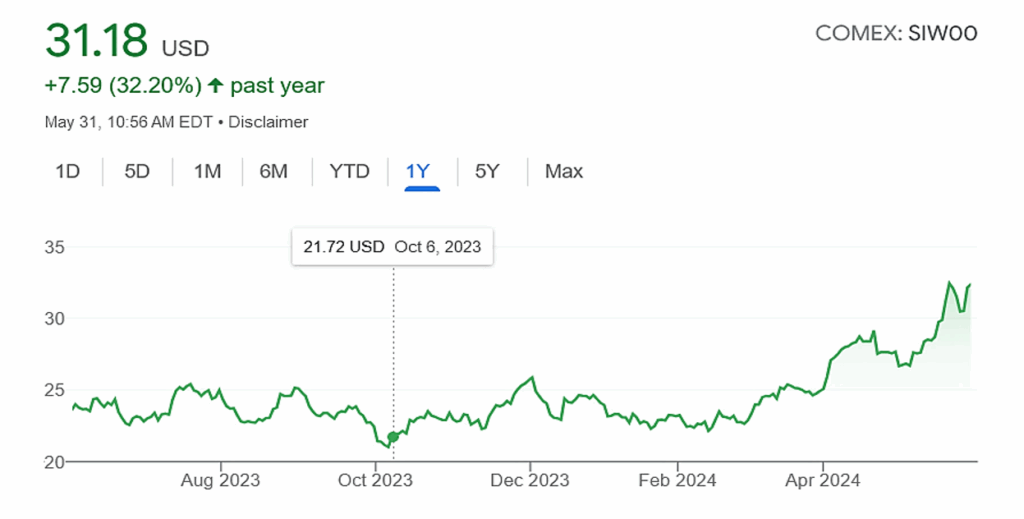
Silver’s story is steeped in history as the jewelry, food vessels, objets d’art, and coins of the ancients were all made from silver.
But it is also a metal with one foot firmly in modernity as a highly conductive catalyst that plays a critical role in the green revolution and the global transition to clean energy.
According to the U.S. Geological Survey, “of all the metals, pure silver has the whitest color, the highest optical reflectivity, and the highest thermal and electrical conductivity.”[2]
Could Silver Double or Even Triple?
Silver’s latest price forecasts range from $34-$35/oz to as high as $50/oz with some outlier predictions for a price surge of up to $100/oz based on rising industrial demand, growing supply deficits, and limited above ground stock. From 2021 to 2023, the Silver Institute estimates there was a cumulative deficit of 474 million ounces of silver, equivalent to 14,743 tons of the white metal.
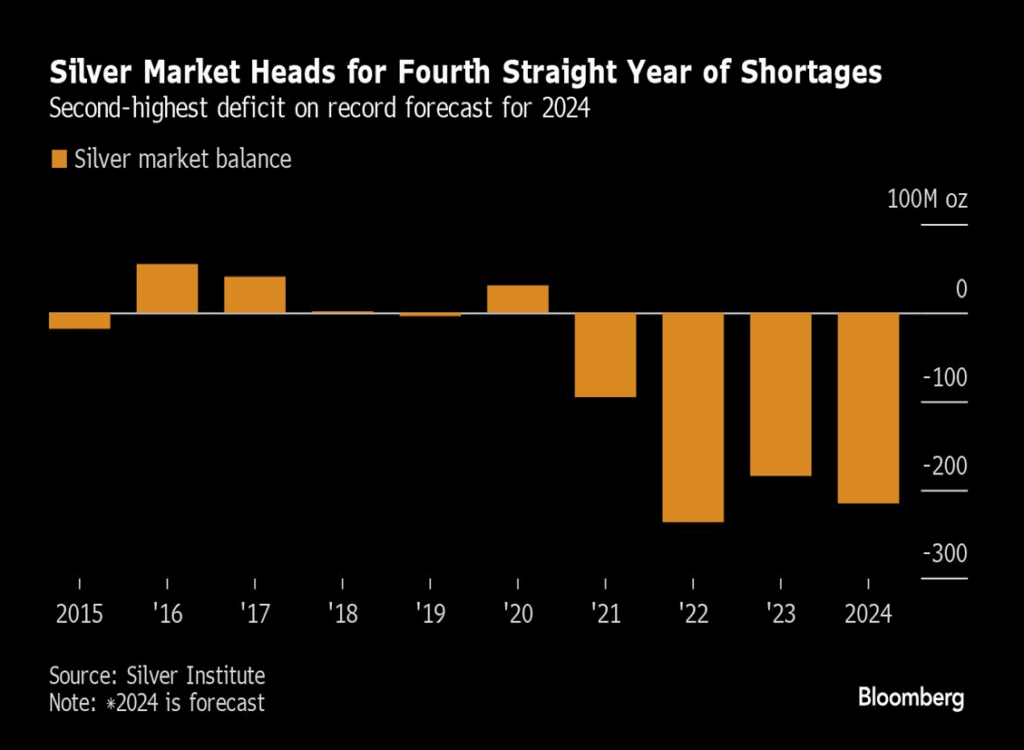
According to MarketWatch
“Forecasts pointing to a fourth straight yearly deficit in global supplies and a rise in demand to its second-highest level on record raise the potential for silver prices to rally, and even roughly double before the end of 2024.”[3]
Supply Challenges Keep Silver Undervalued
Most experts consider silver to be grossly undervalued based upon inherent and uncorrectable supply deficits. As mentioned, silver demand has outpaced supply for the past three years, and according to commodities research group CPM, silver supply is currently in a structural decline that cannot easily be reversed.
“The main issue is the deterioration in mine production, although scrap sources are falling as well. This is important because much of the bullion you and I buy comes from newly-mined silver. Secondary sales (bullion products that have been previously bought and sold) will always have a place in the industry, but to be prepared … mine production will need to be healthy and rising. It is neither of those things.”[4]
It’s important to remember that silver is rarely found in its pure form and excavating silver from the earth is a complex process of extracting and sifting mineral-rich rock and sediment (ore) via open pits and deep underground mines. Silver-bearing ores like copper, lead and zinc must then be crushed, ground, separated and chemically processed to derive pure silver.
This inherently arduous, expensive, and often inefficient process will only become more taxing since most of the silver that’s easiest to mine has already been reached. So, amid the greatest demand pressure in history, silver reserves are dwindling and that should drive silver prices higher well into the foreseeable future.
Investing News recently summarized the silver supply and demand challenges as follows:
“The thinning inventories that contributed to silver’s price gains through Q1 have been driven by the white metal’s increasing demand from industrial sectors. The biggest contributing sectors have come from the energy transition, particularly the production of photovoltaics and electric vehicles.”[5]
The Unstoppable Solar Army
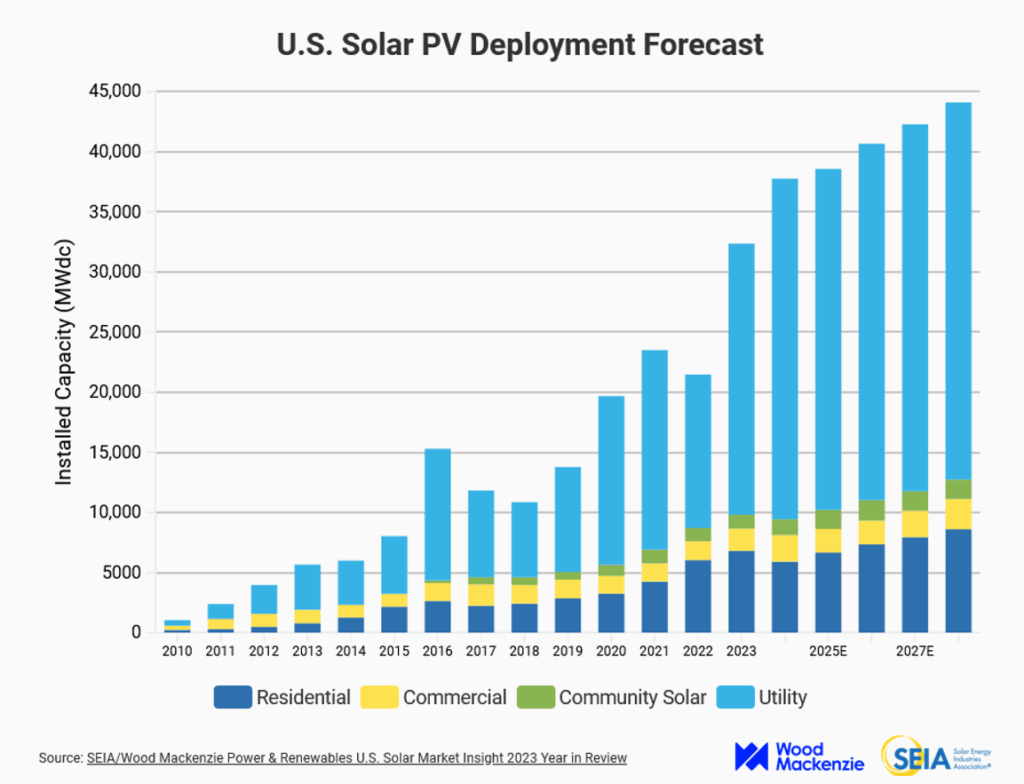
So where does silver go from here? In terms of green energy needs, demand looks elevated well into the end of the decade. Solar energy continues to boom, particularly in the U.S. The Solar Energy Industries Association predicts nothing but silver rooftops and sunshine ahead.
“The total US solar fleet is expected to quadruple over the next decade to 673 GW, as the Inflation Reduction Act provides key tax incentives and long-term certainty that will spark demand for solar and storage and accelerate the transition to renewable energy.”[6]
Breaking Price Barriers and Resistance Levels
Andrew Addison of Barron’s who has been charting silver’s price barriers, resistance levels and upsides for years, believes silver is ready for a dramatic breakout. “Once silver has a monthly close above $31, then my work would confirm upside projections to $45-$55.”[7]
He’s not alone. FX Empire recently stated that, “historically speaking, once we get above the $30 level, it [silver] is a market that tends to just take off to the upside.” And Forbes Advisor Benjamin Curry offers this advice, “It makes sense to invest in silver under certain market conditions. When supply and demand are out of balance is the right time to invest in silver.”
And with silver supply critically constrained and silver demand being inexhaustibly driven by expanding 5G networks, photovoltaics, and consumer electronics — the right time to buy appears to be right now.
AI Demand and Beyond
Global silver demand is expected to reach 1.2 billion ounces this year, the second highest level in recorded history, and there seems no end in sight for silver’s role in industry, manufacturing, renewable energy and beyond.
According to the Silver Institute’s April 2024 Newsletter, “Silver has many exciting new demand opportunities beyond its traditional applications and expanding role in the energy transition. For example, silver will become an indispensable material as artificial intelligence (AI) rises. End uses expected to incorporate silver in AI include transportation, nanotechnology, biotechnology, healthcare, consumer wearables, computing, and energy in data centers.”[8]
Contact Thor Metals Group at 844-944-THOR for information on Investment-Grade Silver
[1] https://www.mining.com/web/hot-commodity-silver-sets-pace-as-demand-and-deficit-drive-rally/
[2] https://www.usgs.gov/centers/national-minerals-information-center/silver-statistics-and-information
[3] https://www.marketwatch.com/story/it-may-be-silvers-turn-to-shine-after-the-gold-rush-to-record-high-prices-e119b3ec
[4] https://cpmgroup.com/update-new-silver-supply-is-drying-up-faster-than-death-valley/
[5] https://investingnews.com/daily/resource-investing/precious-metals-investing/silver-investing/silver-forecast/
[6] https://www.seia.org/solar-industry-research-data
[7] https://www.barrons.com/articles/silver-breakout-what-to-watch-cf9872ac
[8] https://www.silverinstitute.org/wp-content/uploads/2024/05/SNApr2024.pdf
Julian Assange, the founder of WikiLeaks, is known for his role in revealing classified information and confidential documents that shed light on government operations worldwide. Among the myriad of leaks that have drawn public and media attention, one significant revelation pertains to the U.S. government’s alleged gold suppression policy.
Through WikiLeaks, Assange exposed documents that hint at covert strategies employed by the federal government to manipulate gold prices, thereby maintaining the dominance of the U.S. dollar in global markets.
Background on Gold Suppression Policy
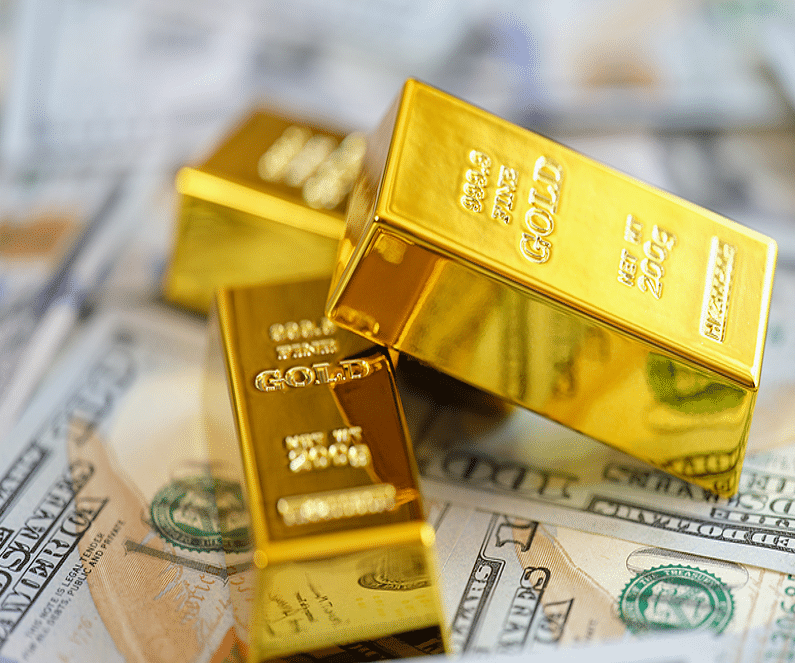
Gold has historically been a cornerstone of economic stability, serving as a hedge against inflation and a reliable store of value. Its significance in the global economy makes it a critical asset for investors and governments alike. The U.S. dollar, as the world’s primary reserve currency, has a unique relationship with gold. A rise in gold prices often signals a lack of confidence in fiat currencies, particularly the dollar. Consequently, a high gold price can undermine the dollar’s value and, by extension, the U.S. economy’s stability.
The alleged gold suppression policy posits that the U.S. government, along with major financial institutions, engages in activities to artificially control and suppress gold prices. This could involve tactics such as large-scale selling of gold reserves or derivative contracts to flood the market and lower prices. The aim would be to make the dollar appear stronger in comparison, sustaining its role as the leading reserve currency.
WikiLeaks, under Assange’s direction, published several documents that suggest the existence of such a policy. One of the most notable leaks was a series of diplomatic cables from the U.S. embassy in Beijing. These cables reveal discussions between U.S. officials and Chinese counterparts, highlighting concerns over China’s growing interest in gold as a way to diversify its reserves away from the dollar. The cables suggest that U.S. officials were worried about the potential impact of China’s gold purchases on the global gold market and, implicitly, on the dollar’s value.
WikiLeaks also released documents from the International Monetary Fund (IMF) that indicate discussions around gold price manipulations. These documents point to collaborative efforts between the U.S. and other Western nations to maintain control over gold prices, ensuring that they remained at levels favorable to the dollar.
Key Implications of the Revelations

The exposure of these documents by WikiLeaks has several significant implications. Firstly, it fuels the long-standing debate over the legitimacy of the gold suppression theory. While some economists and market analysts have long suspected government interference in gold markets, the leaked documents provided a semblance of validation to these claims. The idea that major financial powers could be manipulating gold prices to serve their interests resonated with many, particularly those skeptical of government transparency and accountability.
Secondly, the revelations have a profound impact on the gold market itself. Following the leaks, there was an increase in gold purchases by both private investors and central banks. The perception that gold prices were being artificially suppressed led to a surge in demand, as investors sought to acquire gold before potential corrections could occur. The increased demand put upward pressure on gold prices, ironically counteracting the alleged suppression efforts.
Assange’s Role and the Broader Impact
Julian Assange’s role in exposing the U.S. government’s alleged gold suppression policy underscores the broader mission of WikiLeaks: to promote transparency and accountability by unveiling hidden truths. By publishing classified documents, Assange aimed to inform the public about governmental actions that were conducted behind closed doors, without democratic oversight or consent.
The impact of these revelations extends beyond the financial markets and has sparked discussions on government secrecy and the balance between national security and the public’s right-to-know. Assange’s actions were praised by advocates of transparency and condemned by those who viewed them as reckless and potentially harmful to national interests.
The Hidden Mechanisms of Government
Julian Assange, through WikiLeaks, played a pivotal role in uncovering the U.S. government’s alleged gold suppression policy. The leaked documents provided insights into the covert strategies purportedly employed to manipulate gold prices, highlighting the intricate interplay between economic policies and global power dynamics. While the full extent and impact of these revelations continue to be debated, Assange’s work has undeniably contributed to the unmasking of the hidden mechanisms, policy manipulations, and monetary maneuvers that shape our world — and our economy.
Learn more about Thor Metals Group and get added insights on gold, silver, and market-moving financial news by visiting: www.ThorMetalsGroup.com