An economist has warned that the recent increase in America’s unemployment rate represents an especially concerning signal for the labor market and wider U.S. economy.
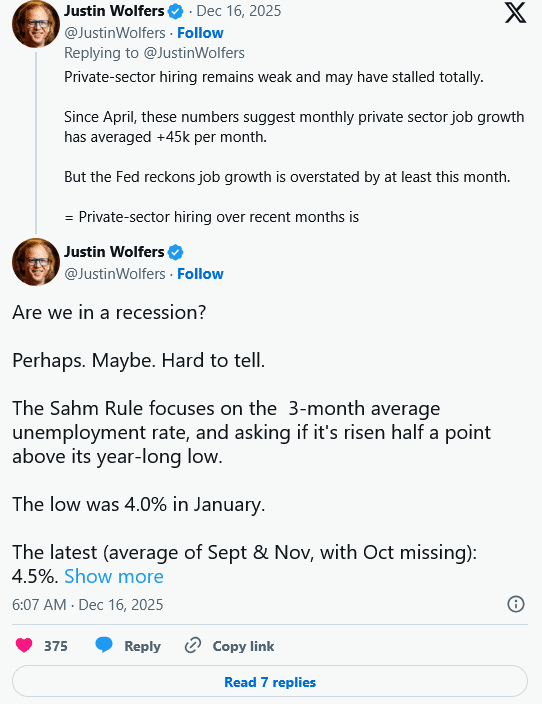
On X, Justin Wolfers, a professor of economics and public policy at the University of Michigan, said it was “hard to tell” whether the U.S. was already in an economic downturn, but pointed to the “Sahm Rule” as one concerning indicator.
This heuristic—employed by the Federal Reserve—charts early stage of recessions by whether the unemployment rate’s three-month moving average has risen 0.5 percent relative to the previous year’s minimum level.
As Wolfers notes, the three-month average climbed to 4.5 for September to November, after hitting a four-year high in Tuesday’s jobs report, compared to 4.0 percent in January.
“That’s up half a point, and it’s blinking red,” Wolfers posted to X.
Why It Matters
Talk of an impending recession eased in the fall, after GDP growth figures came in ahead of expectations and tariffs failed to result in as immediate or significant an increase in prices as some had feared.
However, some economists continue to express fears that it would take only a few shocks—such as the AI “bubble” bursting—to push the country into a major downturn, and that many states may already be in decline.
President Donald Trump gave his economy a grade of “A+++++” in a recent interview with Politico, but the tail end of 2025 has seen more Americans grappling with high and rising costs, surveys detailing consecutive drops in consumer confidence and, as Wolfers notes, a monthslong slowdown in hiring that is now combining with an uptick in layoff announcements.
What To Know
Wolfers, a frequent critic of the Trump administration’s economic agenda, issued his warning following Tuesday’s employment report, which combined payroll figures for October and November, given delays to regular releases due to the government shutdown.
The Bureau of Labor Statistics (BLS) revealed that the economy added 64,000 jobs in November, ahead of most forecasts, but shed 105,000 in October. The BLS said October’s decline was largely driven by government employees who accepted the administration’s deferred resignation offer earlier this year, and who came off the federal payrolls during the month.
While economists were pleased to get government employment data after a lengthy shutdown-induced fast, Bankrate senior economic analyst Mark Hamrick told Newsweek: “The not-so-good news is that it isn’t pretty.”
Job gains for the previous two months were also revised down by a total of 33,000, and as Wolfers wrote on Tuesday: “The headline numbers suggest VIRTUALLY NO EMPLOYMENT GROWTH since April.” Meanwhile, the unemployment rate rose to 4.6 percent, its highest level since September 2021, informing his pessimistic reading of the Sahm Rule.
But Claudia Sahm, the former Federal Reserve economist who developed the measure, told Newsweek that while rising unemployment “is a concern,” it is not yet “at levels typically seen in the early stages of a recession.”
She added that an extra complication was the Sahm Rule’s reliance on a three-month average, and the absence of an October unemployment rate, which the BLS did not calculate or release citing data collection issues caused by the shutdown.
“I would be cautious with standard ‘rules of thumb’ for the next few months,” she told Newsweek.
What People Are Saying
Market analyst Daniela Hathorn, in comments shared with Newsweek following Tuesday’s report, said: “The figures confirm that job growth remains modest and the labor market continues to slow, with 64,000 payrolls added in November after a dip in October, a clear deceleration from prior months. The unemployment rate rose slightly higher than expected at 4.6 percentage, further softening from earlier in the year, and wage growth continues to ease modestly compared with previous months. All told, this is consistent with a labor market that is losing steam rather than overheating.”
Kevin Hassett, director of the National Economic Council, told CNBC after the reading: “We dropped about 160,000 government workers—federal government—who are the people who took the buyout that, you know, we began that program in spring and gave people until the fall to step aside. And so, I think that from the private sector point of view it’s just about what we’ve been getting all year. It’s [a] solid upward trajectory.”
Read the full article HERE.